Water: MP2 and CCSD(T) Energies
Hartree–Fock treats each electron in the average field of the others. The difference from the exact energy is the correlation energy. MP2 recovers most of it at low cost, and CCSD(T), the usual reference method for small molecules, recovers more. This example computes both for water in the cc-pVDZ basis set.
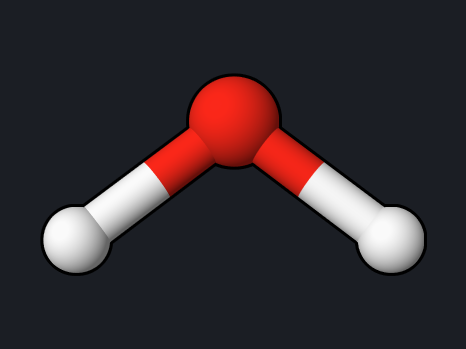
Copy and run
mp2/cc-pvdz
geom="""
O      0.000000     0.000000     0.122745
H      0.000000     0.759541    -0.471922
H      0.000000    -0.759541    -0.471922
"""
ccsd_t/cc-pvdz
geom="""
O      0.000000     0.000000     0.122745
H      0.000000     0.759541    -0.471922
H      0.000000    -0.759541    -0.471922
"""
Download water-mp2.oqp · Download water-ccsdt.oqp
openqp water-mp2.oqp
openqp water-ccsdt.oqp
Both start from an RHF reference. All electrons are correlated, including the
oxygen 1s pair; add cc(nfzc=1) to the CCSD(T) route to freeze it. cc-pVDZ uses
spherical d functions, so water has 24 basis functions. Each run takes 2–3
seconds.
What you get
The MP2 block of water-mp2.log separates same-spin and opposite-spin pairs:
  E(reference, SCF)      =       -76.0263514813
  E(MP2, same-spin total)=        -0.0516187358
  E(MP2, opp-spin  ab)   =        -0.1529199712
  E(MP2, correlation)    =        -0.2045387069
  E(MP2, total)          =       -76.2308901882
The CCSD(T) run starts its iterations from the MP2 amplitudes and reports:
  E(reference, SCF)      =       -76.0263514813
  E(CCSD, correlation)   =        -0.2138605036
  E(CCSD, total)         =       -76.2402119848
  E((T), correction)     =        -0.0030969638
  E(CCSD(T), correlation)=        -0.2169574674
  E(CCSD(T), total)      =       -76.2433089486
| Method | Total energy (hartree) | Correlation energy (hartree) |
|---|---|---|
| RHF | −76.0263515 | — |
| MP2 | −76.2308902 | −0.2045387 |
| CCSD | −76.2402120 | −0.2138605 |
| CCSD(T) | −76.2433089 | −0.2169575 |
MP2 recovers 94% of the CCSD(T) correlation energy here, and the perturbative triples (T) add 3.1 millihartree (1.9 kcal/mol) to CCSD. Differences of this size matter for reaction energies, which is why CCSD(T) is used to benchmark cheaper methods.
Cross-check
PySCF 2.13 at the same geometry and basis set, with all electrons correlated, gives RHF −76.02635148, MP2 −76.23089019, CCSD −76.24021200, and CCSD(T) −76.24330897 hartree. OpenQP agrees to 10⁻⁸ hartree.
Try next
- Freeze the oxygen core with
ccsd_t/cc-pvdz cc(nfzc=1): the CCSD(T) correlation energy becomes −0.2148543 hartree, 2.1 millihartree smaller in magnitude. - Repeat with
cc-pvtz: the CCSD(T) correlation energy grows to −0.2891606 hartree, one third larger than with cc-pVDZ. Correlation energies converge slowly with the basis set, which is why correlated calculations need larger basis sets than HF or DFT.
See also: MP2, Coupled Cluster.