Ammonia Inversion: Nudged Elastic Band (NEB)
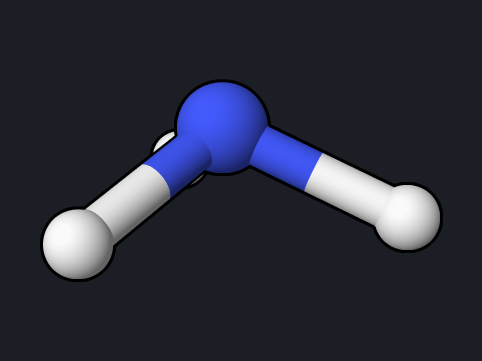
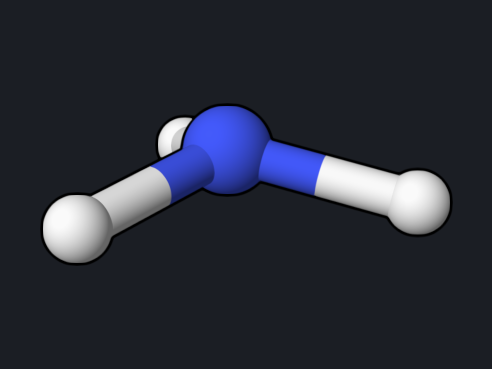
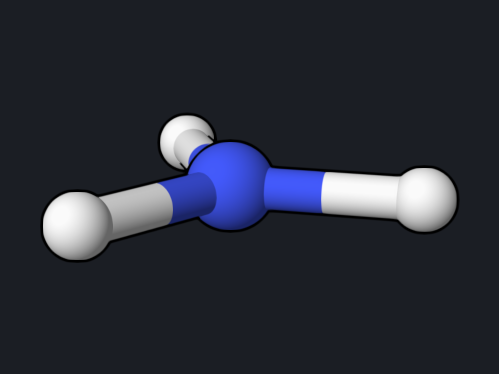
The nudged elastic band (NEB) method finds a reaction path between two known structures without a transition-state guess: a chain of intermediate structures (images) connected by springs is relaxed until it lies along the minimum-energy path. Ammonia turns inside out like an umbrella through a planar transition state; the barrier is small and well known, which makes it a clean NEB test.
Copy and run
The NEB needs the reactant in the input and the product as a separate XYZ file. Download both into one folder: nh3-neb.oqp and nh3-inverted.xyz.
dft/pbe0/6-31g* neb(S0,product="nh3-inverted.xyz",images=9) dftgrid(rad_npts=150,ang_npts=974)
geom="""
N      0.000000     0.000000     0.098477
H      0.000000     0.937185    -0.295432
H     -0.811626    -0.468592    -0.295432
H      0.811626    -0.468592    -0.295432
"""
4
NH3 with the umbrella inverted (mirror image through the xy plane)
N      0.000000     0.000000    -0.098477
H      0.000000     0.937185     0.295432
H     -0.811626    -0.468592     0.295432
H      0.811626    -0.468592     0.295432
openqp nh3-neb.oqp
- The reactant is the PBE0/6-31G* minimum (from nh3-opt.oqp, r(N–H) = 1.017 Å, ∠HNH = 105.9°); the product is its mirror image.
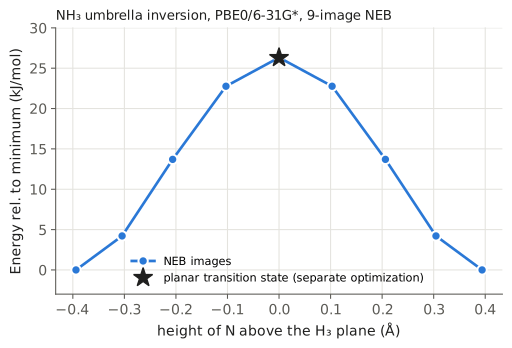
neb(S0,product=...,images=9)relaxes a band of nine images, including the two fixed end points, on the ground-state surface. Both end points should be minima of the same method, basis set and integration grid.dftgrid(rad_npts=150,ang_npts=974)replaces the default SG2 grid with a denser 150 × 974-point grid; every input on this page uses it. The default grid is not symmetric under the three-fold rotation of NH₃, so it moves the energy by about 1e-5 hartree when the molecule is rotated and splits the degenerate vibrational frequencies by up to 2 cm⁻¹. The denser grid removes both effects, at about ten times the cost.
The run takes about 7 minutes on 4 threads (under a minute with the default grid) and converges in 22 band iterations:
   PyOQP: NEB Has Converged (fmax=1.604e-03, frms=5.392e-04 in 22 iters)
   PyOQP: Native NEB path written to .../nh3-neb_neb.xyz
What you get
nh3-neb_neb.xyz contains all nine images as one multi-frame XYZ file, with
the energy of each image in its comment line; open it in OQP Studio, VMD, or
Avogadro to play the path. The energies:
| Image | 1 | 2 | 3 | 4 | 5 | 6 | 7 | 8 | 9 |
|---|---|---|---|---|---|---|---|---|---|
| E − E(min), kJ/mol | 0.00 | 4.21 | 13.70 | 22.76 | 26.32 | 22.76 | 13.70 | 4.21 | 0.00 |
Check the top of the band
The highest image is close to, but not exactly at, the transition state. To confirm it, optimize the planar structure directly (nh3-planar-opt.oqp): started from an exactly planar geometry, the D3h symmetry keeps it planar and the optimization lands on the saddle point, r(N–H) = 0.999 Å. A Hessian there (nh3-planar-ts.oqp) has exactly one imaginary frequency, the umbrella motion, and the degenerate pair of bending modes (modes 2 and 3) agrees to 0.01 cm⁻¹:
   Mode  Symmetry     Frequency(cm-1)      IR(km/mol)      Raman(bohr^4/amu)
      1        b1           -890.85       591.962256             0.000000
      2        b2           1608.52        44.254929            28.998035
      3        a1           1608.53        44.253845            29.000777
This table is from GitHub main commit 0b75a06, which includes the IR unit
fix openqp#533;
older builds print the same frequencies with IR intensities 23 times smaller.
| Quantity | Reference value |
|---|---|
| Highest NEB image | 26.32 kJ/mol |
| Optimized planar transition state | 26.30 kJ/mol (−56.4672609 hartree) |
| Pyramidal minimum | −56.4772790 hartree |
| Experiment (inversion barrier) | about 24 kJ/mol |
The same transition state by QST2
When both end points are known, a QST2 (quadratic synchronous transit) search locates the transition state directly, without a band of images:
dft/pbe0/6-31g* ts(S0,search="qst2",product="nh3-inverted.xyz") dftgrid(rad_npts=150,ang_npts=974)
geom="""
N      0.000000     0.000000     0.098477
H      0.000000     0.937185    -0.295432
H     -0.811626    -0.468592    -0.295432
H      0.811626    -0.468592    -0.295432
"""
Download nh3-qst2.oqp (uses the same
nh3-inverted.xyz)
ts(S0,search="qst2",product=...) builds a guess between the two end points
and refines it as a transition-state search. It converges in 7 steps, in about
20 seconds, to −56.4672609 hartree, the same planar structure as the direct D3h
optimization above (r(N–H) = 0.999 Å). With a third structure close to the
transition state, search="qst3" with guess="..." uses it as an additional
hint.
| Method | Barrier | Runtime |
|---|---|---|
| NEB, highest of 9 images | 26.32 kJ/mol | 7 min |
| QST2 transition-state search | 26.30 kJ/mol | 20 s |
| D3h optimization of the planar structure | 26.30 kJ/mol | — |
NEB gives the whole path; QST2 gives only the transition state, but faster.
Reading the result
- The band finds the path without a guess. Starting only from the two end points, NEB places its highest image within 0.02 kJ/mol of the separately optimized transition state.
- The path is symmetric, as it must be for a reaction between mirror images, and the barrier is close to experiment.
- Choose end points that define a meaningful path. NEB starts from an interpolation between the end points. For a reaction such as HCN → HNC, where both end points are linear, the straight-line interpolation moves the hydrogen through the C≡N bond; use a transition-state search with a bent guess instead (see the HCN example).
Try next
- Use more images,
images=15, and compare the highest energy. - Use the highest image as the starting structure of a
ts(S0)search for a transition state that is not fixed by symmetry.
See also: Transition-State Searches,
neb.