Formaldehyde: X-ray Absorption (Core Excitations)
X-ray absorption spectroscopy (XAS) excites an electron out of a 1s core
orbital. Each element absorbs in its own energy window (the K-edge), so the
spectrum is element-specific: carbon near 285 eV, oxygen near 530 eV. MRSF-TDDFT
can reach these core states directly with the ixcore option, without
computing the hundreds of valence states below them.
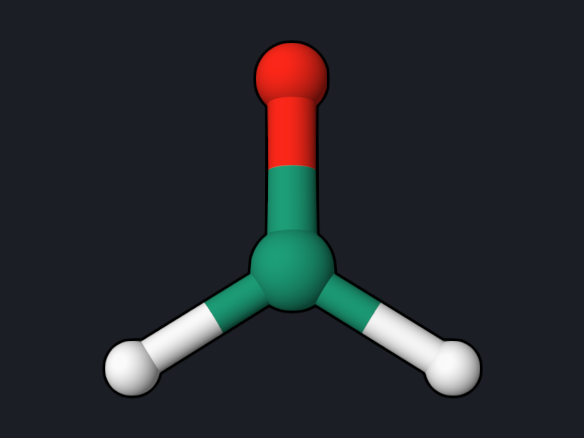
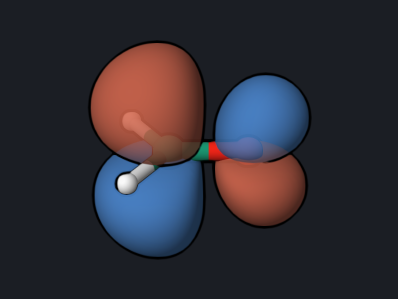
Copy and run
The carbon K-edge:
mrsf(nstate=70)/bhhlyp/6-31g* energy(S0) tdhf(ixcore=2)
geom="""
C      0.000000     0.000000    -0.526342
O      0.000000     0.000000     0.676110
H      0.000000     0.937620    -1.119884
H      0.000000    -0.937620    -1.119884
"""
Download formaldehyde-xas-c.oqp ·
formaldehyde-xas-o.oqp (oxygen K-edge,
tdhf(ixcore=1))
openqp formaldehyde-xas-c.oqp
tdhf(ixcore=N)selects molecular orbital N as the core orbital. The orbitals are numbered by energy: orbital 1 is O 1s and orbital 2 is C 1s. OpenQP shifts the response equations so that excitations out of this orbital are found among the computed states.nstate=70leaves room for the valence states that are still computed;energy(S0)follows the repository XAS example.
Each run takes about 5 seconds.
What you get
The transitions from S0 are listed after the excited-state summary table. For the carbon K-edge:
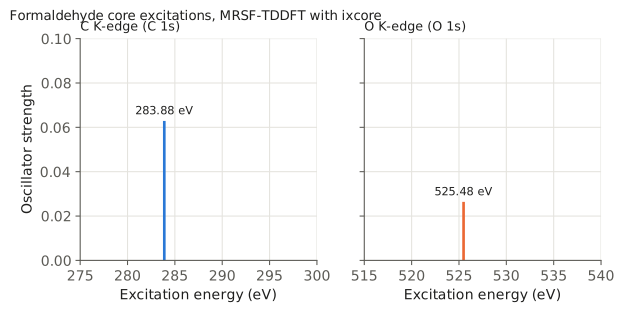
   S0 -> S53  283.882898        ...      0.0629
   S0 -> S54  284.616185        ...      0.0000
| Edge | Transition | Energy | Oscillator strength | Experiment |
|---|---|---|---|---|
| C K-edge | C 1s → π* | 283.88 eV | 0.063 | about 286.0 eV |
| O K-edge | O 1s → π* | 525.48 eV | 0.026 | about 530.8 eV |
The same input for HCN (hcn-xas-c.oqp) gives its carbon 1s → π* transition at 285.55 eV with an oscillator strength of 0.050, the value quoted for the corresponding repository example.
Reading the result
- Each edge has one strong 1s → π* line. Like valence MRSF-TDDFT, the core states come from spin flips out of the high-spin reference; only the excitation from the core orbital into the LUMO (π*) is a single excitation in this construction, so higher core-excited states appear with very small intensity.
- The energies are 2–6 eV below experiment. Linear-response core
excitations with a hybrid functional and a small basis set are not expected
to give absolute edge positions, and this calculation does not relax the
orbitals around the core hole. The repository's
examples/XASfolder also contains the ΔCHP-MRSF approach, which includes core-hole relaxation throughguess(swapmo=...),scf(rstctmo=true), andixcore. - The ordering of the edges is element-specific: the 240 eV gap between the C and O lines is what makes XAS a probe of individual atoms.
Try next
- Compute the nitrogen K-edge of HCN by selecting the N 1s orbital, which is orbital 1 in HCN.
- Use a basis set with core polarization functions, such as
cc-pcvdz, and compare the edge positions.
See also: MRSF-TDDFT,
tdhf keywords.