Ethylene with SF-TDDFT: Spin Contamination
Spin-flip TDDFT (SF-TDDFT) starts, like MRSF-TDDFT, from a high-spin triplet reference and flips one spin to reach the singlet ground state and excited states. Its response states, however, are not guaranteed to be pure singlets or triplets. This example repeats the ethylene twist with SF-TDDFT and uses ⟨S²⟩ to identify the spin of each root, which shows why MRSF-TDDFT was developed.
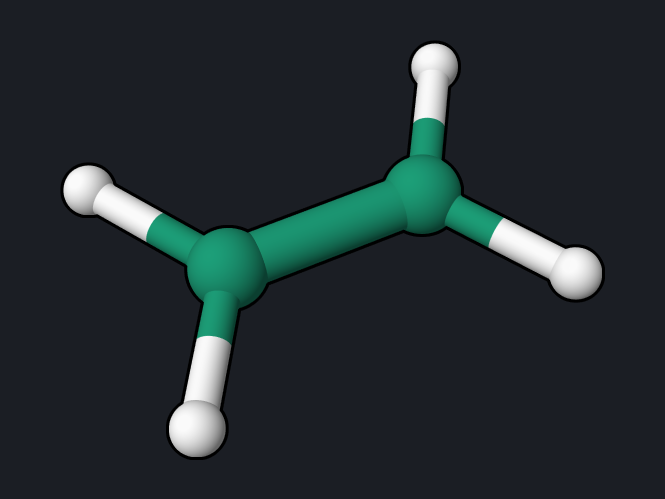
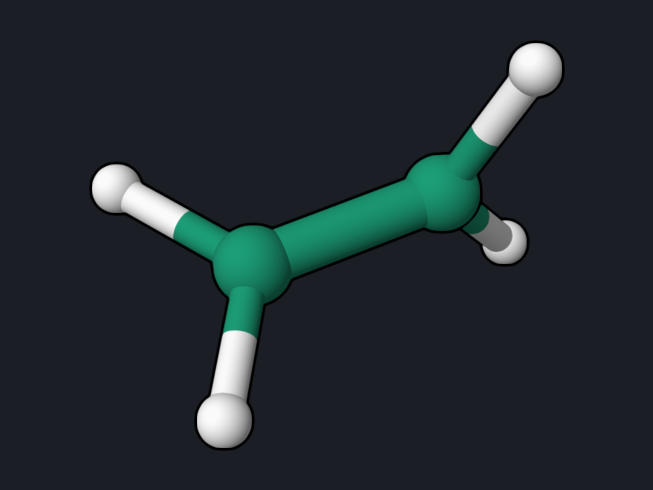
Copy and run
sf(nstate=4)/bhhlyp/6-31g*
geom="""
C      0.000000     0.000000     0.664311
C      0.000000     0.000000    -0.664311
H      0.000000     0.923944     1.237411
H      0.000000    -0.923944     1.237411
H      0.000000     0.923944    -1.237411
H      0.000000    -0.923944    -1.237411
"""
Download ethylene-planar-sf.oqp · ethylene-twisted-sf.oqp (the 90° geometry from the twist example)
openqp ethylene-planar-sf.oqp
sf(nstate=4) requests four spin-flip roots. The geometry and the
BHHLYP/6-31G* level are the same as in the MRSF twist example, so the two
methods can be compared directly. Each run takes about 2 seconds. For the full
scan, use the script on the twist page with the first line
sf(nstate=4)/bhhlyp/6-31g*.
What you get
SF-TDDFT prints a summary table with ⟨S²⟩ for every root. For planar ethylene:
 State      Energy       Excitation   Excitation(eV)  <S^2>         Transition dipole moment, a.u.        Oscillator
           Hartree           eV          rel. GS                  X          Y          Z        Abs.      strength
   1    -78.5258933521    -4.269938     0.000000      0.004     0.0000     0.0000     0.0000     0.0000      0.0000
   0    -78.3689760267     0.000000     4.269938        (ROHF/UHF Reference state)
   2    -78.3414039996     0.750273     5.020211      1.999     0.0000     0.0000    -0.0000     0.0000      0.0000
   3    -78.2207343818     4.033861     8.303799      1.005    -0.0000     0.0000     0.0000     0.0000      0.0000
   4    -78.2183549845     4.098607     8.368545      0.012     0.0000     0.0000    -0.0000     0.0000      0.0000
State 0 is the high-spin triplet reference, not a response root. The roots are numbered by energy, whatever their spin: ⟨S²⟩ ≈ 0 means a singlet, ⟨S²⟩ ≈ 2 a triplet, and a value in between a mixture of the two.
| Root | Planar (0°) | ⟨S²⟩ | Twisted (90°) | ⟨S²⟩ |
|---|---|---|---|---|
| 1 | 0.000 eV | 0.004 (S0) | −78.3961119 hartree | 1.999 (triplet) |
| 2 | 5.020 eV | 1.999 (triplet) | −78.3957383 hartree | 0.007 (S0) |
| 3 | 8.304 eV | 1.005 (mixed) | 2.19 eV above root 2 | 0.053 |
| 4 | 8.369 eV | 0.012 | 2.25 eV above root 2 | 0.055 |
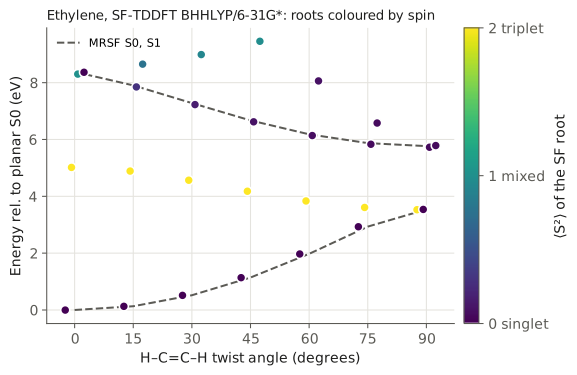
The coloured points are the four SF roots at each angle, coloured by ⟨S²⟩; the dashed lines are MRSF-TDDFT S0 and S1 from the twist example.
Reading the result
- The SF ground state is fine. SF root 1 at 0° (−78.5258934 hartree) and the singlet root at 90° (−78.3957383 hartree) agree with MRSF-TDDFT S0 (−78.5257616 and −78.3957310 hartree) to within 0.13 millihartree.
- Some SF roots are half singlet, half triplet. At the planar geometry root 3 has ⟨S²⟩ = 1.005, and between 15° and 45° roots 3 and 4 have ⟨S²⟩ between 0.1 and 1.0. Such a root is not a physical state: its energy and properties mix those of a singlet and a triplet. MRSF-TDDFT removes this spin contamination by construction: its S1 (dashed line) has ⟨S²⟩ ≤ 0.003 at every angle.
- Root order changes with spin. At 90° the triplet falls below the singlet,
so root 1 is the triplet and S0 is root 2. Because the spin of a root is known
only after the calculation, SF state-specific inputs use root numbers,
for example
grad(root=2), neverS0orT1; see SF-TDDFT.
Try next
- Compute the gradient of a chosen root after checking its ⟨S²⟩ in an energy
run at the same geometry: for the twisted input,
grad(root=2)gives the gradient of the singlet S0. - Compare with
mrsf(nstate=3)/bhhlyp/6-31g*at the same geometry, which returns only singlets (S0, S1, S2), and withenergy(T0)for the triplets.
See also: SF-TDDFT, MRSF-TDDFT.