Benzene: Ring Current and Aromaticity (ACID)
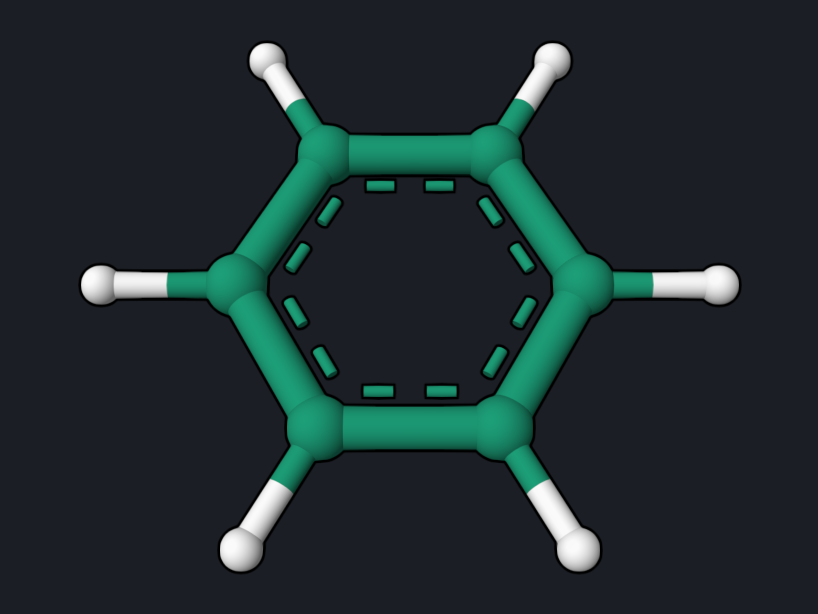
The anisotropy of the induced current density (ACID) shows where electrons are delocalized when a magnetic field is applied. In a conjugated ring the ACID isosurface forms a continuous belt around the ring, and the induced current vectors show which way the ring current flows. A diatropic ring current is the signature of aromaticity and causes the downfield shift of benzene protons in NMR.
Copy and run
hf/6-31g* nmr(gauge=giao,acid=true)
geom="""
C      1.392883     0.000000     0.000000
C      0.696465     1.206259     0.000000
C     -0.696465     1.206259     0.000000
C     -1.392883     0.000000     0.000000
C     -0.696465    -1.206259     0.000000
C      0.696465    -1.206259     0.000000
H      2.479666     0.000000     0.000000
H      1.239913     2.147463     0.000000
H     -1.239913     2.147463     0.000000
H     -2.479666     0.000000     0.000000
H     -1.239913    -2.147463     0.000000
H      1.239913    -2.147463     0.000000
"""
openqp benzene-acid.oqp
nmr(gauge=giao,acid=true) runs the GIAO NMR calculation and also evaluates
the current density on a grid. The run takes about 40 seconds.
What you get
Besides the NMR shieldings in the log, OpenQP writes four Gaussian cube files:
ACID cubes written: benzene-acid_acid.cube, benzene-acid_jx.cube, benzene-acid_jy.cube, benzene-acid_jz.cube
| File | Contents |
|---|---|
benzene-acid_acid.cube |
the ACID scalar field |
benzene-acid_jx.cube, _jy, _jz |
the induced current-density vector for a field along z, perpendicular to the ring |
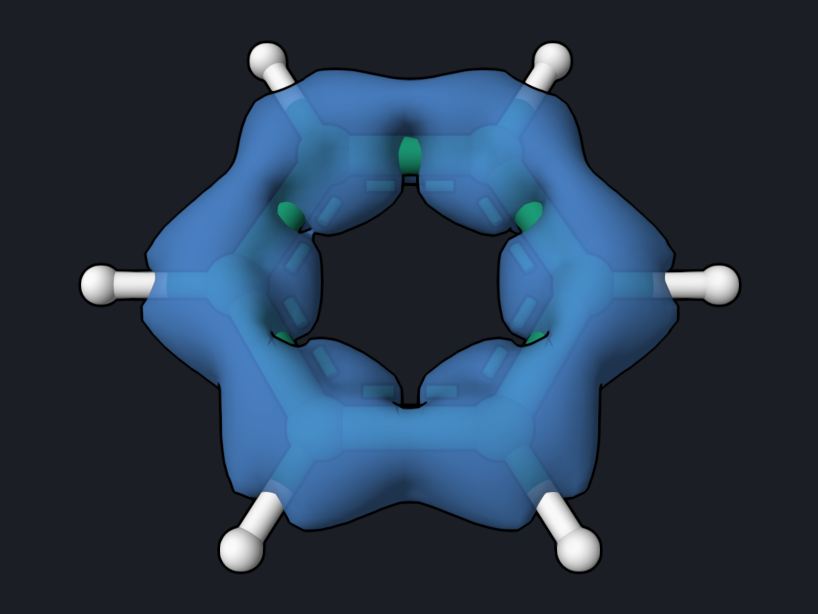
Open benzene-acid_acid.cube in OQP Studio Analysis, set the isovalue to 0.05,
and show the surface; the picture above is the Studio 3D viewer at this isovalue. The vector cubes
can be drawn as arrows in OQP Studio 0.2.6 and later, or in VMD or Multiwfn.
Reading the result
- The isosurface is one connected belt following the six C–C bonds, with no breaks between bonds. Continuity shows that the π electrons are delocalized around the whole ring. It does not by itself show aromaticity: an antiaromatic ring can also give a connected surface.
- Aromatic and antiaromatic rings differ in the direction of the current.
For B along z, a diatropic (aromatic) current circulates clockwise seen
from the +z side, and a paratropic (antiaromatic) one counter-clockwise (see
ACID Current-Density Maps). Averaging
r × j from
benzene-acid_jx.cubeandbenzene-acid_jy.cubeon circles around the ring axis gives a clockwise circulation on the ring (r = 1.4 Å) and outside it, both in the ring plane and 0.5–1.0 Å above it: the benzene current is diatropic. Only inside the ring in the molecular plane (r = 1.0 Å, z = 0) does the circulation reverse, which is the known inner paratropic contribution. - In the ACID literature, saturated rings show surfaces that break into separate bond regions at the same isovalue; the cyclohexane run suggested below tests this directly.
Try next
- Run the same calculation for cyclohexane and compare the topology of the surface, and for cyclobutadiene and compare the direction of the current (draw the vector cubes as arrows, or repeat the r × j average above).
- Change the isovalue in Studio and note the value at which the belt breaks apart.
See also: ACID Current-Density Maps, NMR chemical shifts example.