
Published research
Electronic states, molecular motion and spectra.
Our research develops MRSF-TDDFT and applies it to the molecular processes following light absorption. The studies below connect a specific scientific question to the method and the published evidence.
Method development
Complementary spin-flip responses from a mixed reference.
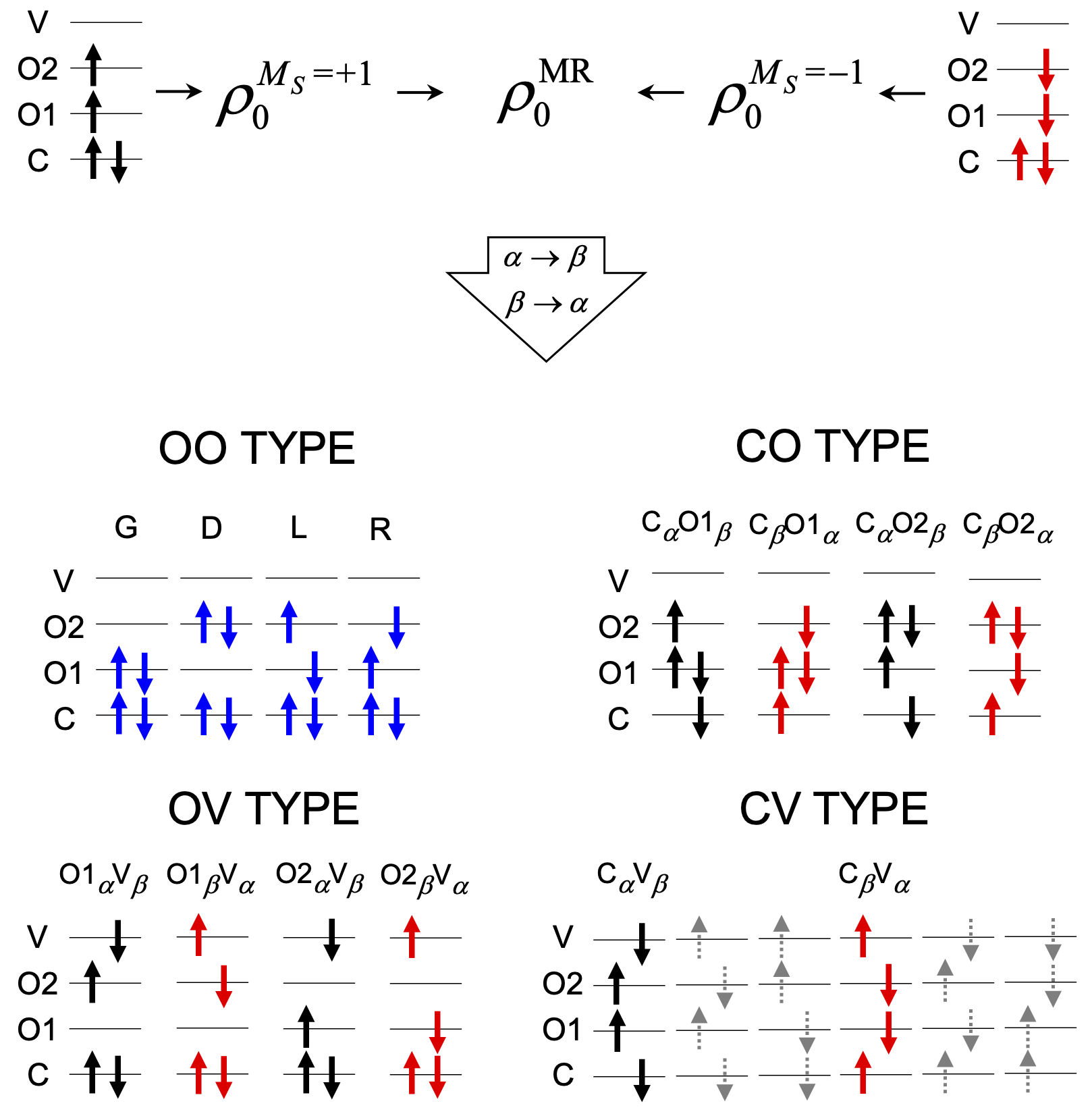
Conventional spin-flip TDDFT starts from one high-spin reference and omits complementary electronic configurations. MRSF-TDDFT uses an equal mixture of the MS = +1 and −1 reference densities. The resulting response includes additional configurations important for a more balanced description of low-lying singlet states.
The theory describes selected doubly excited configurations associated with the two singly occupied orbitals. It does not include every double excitation; the configuration space and remaining spin-contamination limitations matter when interpreting a result.
Analytic derivatives
Excited-state structures and conical intersections.
A vertical excitation energy alone cannot determine a photochemical pathway. Analytic energy gradients allow the nuclei to relax on an excited-state potential-energy surface and support searches for minimum-energy conical intersections.
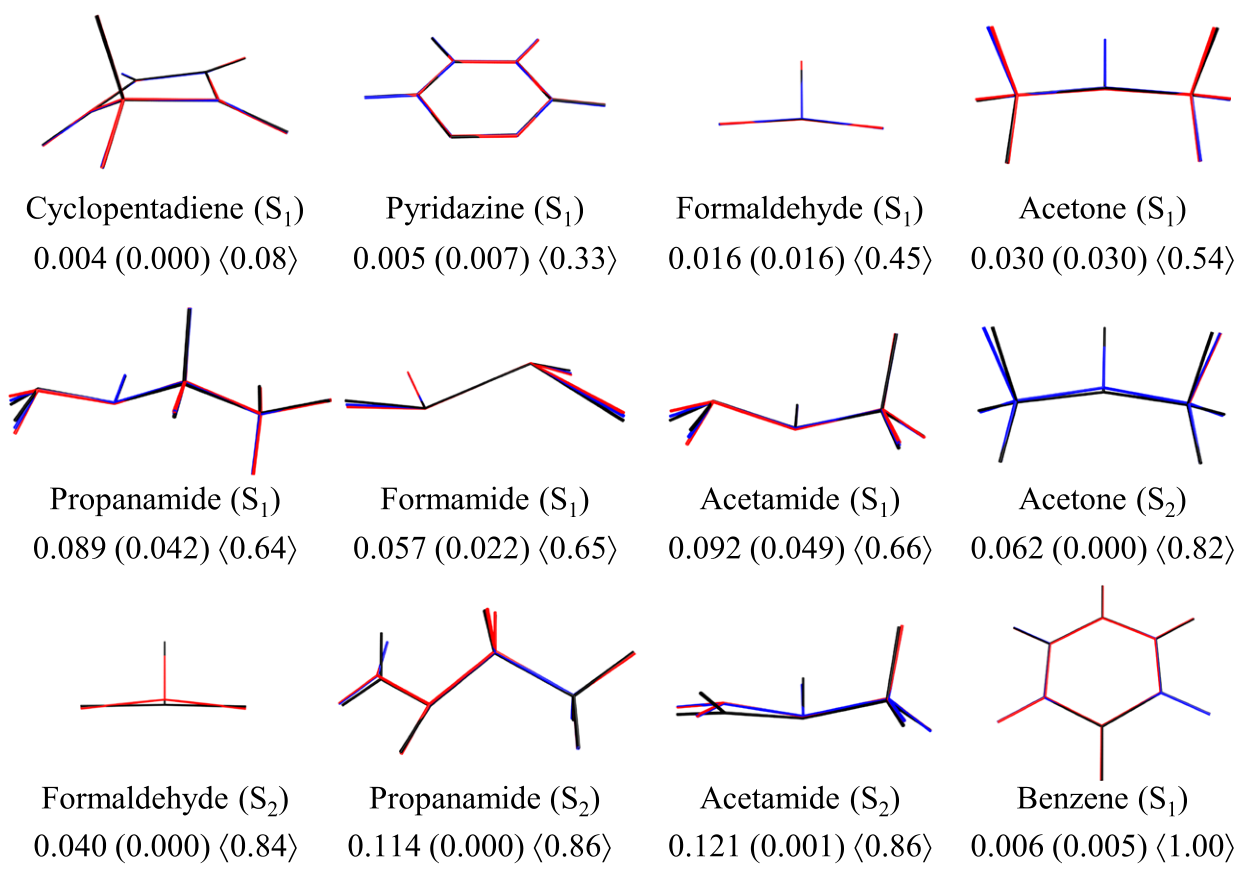
The 2019 study derived MRSF-TDDFT gradients, compared optimized structures with SF-TDDFT and EOM-CCSD references, and examined a conical intersection of the protonated Schiff-base model PSB3. The figure shows why differences in electronic-state descriptions can produce different molecular geometries.
Core excitation, ionization and spin–orbit coupling
Connecting electronic structure with observed spectra.
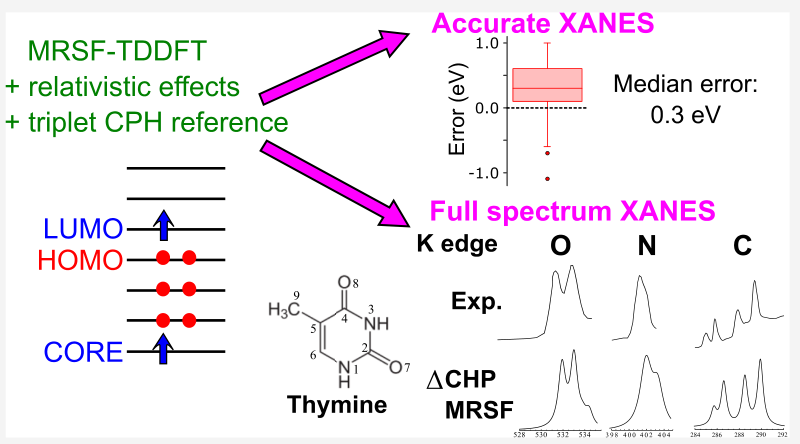
Core electrons distinguish atomic sites, but creating a core hole also changes the orbitals. The 2022 X-ray absorption study treated this relaxation explicitly and included scalar relativistic effects. It compared molecular K-edge excitation energies and assigned features in thymine spectra, including excitations from valence-excited states.
Related research addresses electron removal through extended Koopmans’ theorem and coupling between states of different spin through spin–orbit interactions. These are distinct properties with their own approximations and published comparisons.
Photochemistry in molecular environments
Following relaxation after photoexcitation.
Nonadiabatic dynamics follows nuclear motion while allowing transitions between electronic states. Our studies examine the competition between relaxation pathways in nucleobases and molecular chromophores. QM/MM extends this description to a molecule interacting with its surroundings, where changes in geometry and electrostatics can alter the reaction.
Scientific software
OpenQP makes the methods usable.
The 2024 OpenQP paper describes the quantum-chemistry library and its Python tools for combining electronic energies, gradients and molecular calculations. Published research establishes the scientific method; the current manual and release pages identify which calculations a particular software version provides.