In development
Analytic nc-CV gradients
Analytic nuclear gradients and geometry optimization for supported nc-CV-MRSF states are being developed and validated. Coupling vectors and Hessians are outside this gradient preview.

Upcoming version 1.4.0
Faster energy and gradient calculations, with more accurate analytic gradients and more robust SCF convergence.
1.4.0 preview build · 9 November 2026
Whole-calculation benchmark
Thymine · spherical cc-pVDZ · four CPU threads · 1.4.0 preview build.
Faster
Numerical agreement criterion unmet
Faster
Numerical agreement criterion unmet
Numerical agreement criterion unmet
Numerical agreement criterion unmet · timing control inconclusive
Absolute error in hartree/bohr · Logarithmic scale. O atom 7, z component · Absolute difference from energy finite differences.
Absolute error in hartree/bohr · Logarithmic scale. O atom 7, z component · Absolute difference from energy finite differences.
Absolute error in hartree/bohr · Logarithmic scale. O atom 7, z component · Absolute difference from energy finite differences.
One Cartesian component per method. The component with the largest difference was selected for comparison against energy finite differences.
Numerical agreement criterion unmet
The 1.4.0 measurements use the preview build from 9 November 2026. Both builds used the same machine, compiler, BLAS library, geometry, Hückel guess and SCF tolerance of 10−9. DFT and MRSF used BHHLYP on an unpruned 150 × 590 Becke grid. MRSF calculated three singlet roots and the analytic gradient of S1.
The ratio is 1.4.0 preview time divided by 1.3.1 time. Each pair includes process startup and result output. A ratio requires agreement within 10−8 hartree in energy and 10−6 hartree/bohr in gradient components, together with a stable repeated-baseline control.
The Z-vector times use the same wall-clock instrumentation in both builds. The whole-job time includes SCF, response, Z-vector, gradient evaluation and calculation overhead.
Gradient checks use the component with the largest analytic difference in each listed case. Central energy differences at 0.001 and 0.0005 bohr were extrapolated to zero step size.
Separate MRSF response benchmark

Naphthalene · BHHLYP/6-31G* · 3 singlet roots · FP64 · 8 CPU threads · 3 measured rounds after warm-up.
Both calculations converged in 7 response iterations. Optimized/standard response-time ratio: 0.4007 (95% confidence interval 0.3962–0.4017). The repeated-baseline control showed no significant change; maximum signed state-energy difference was 3.83 × 10⁻¹² hartree. Spin-pair reuse was enabled. This recorded optimization benchmark is not a new comparison of the final 1.4.0 and 1.3.1 binaries.
Analytic-gradient verification
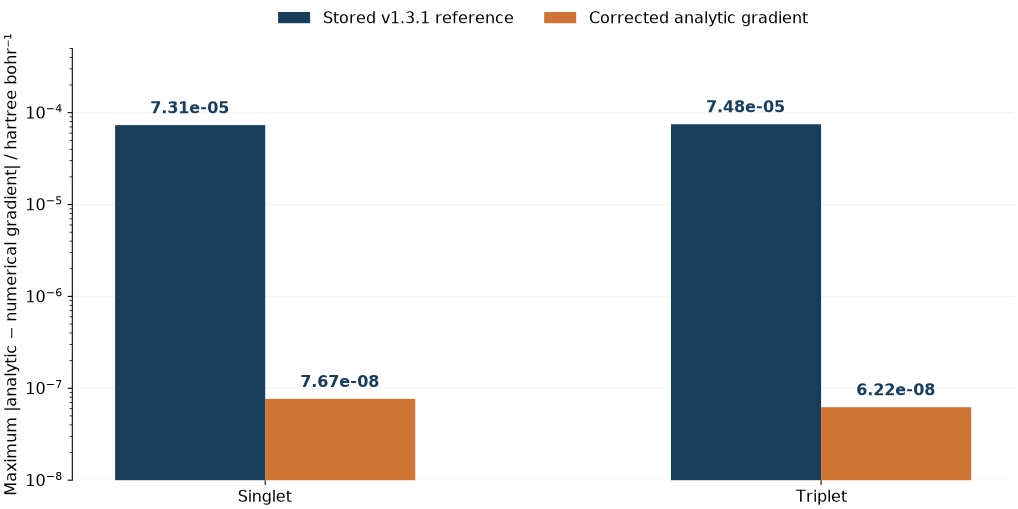
| Calculation | Stored 1.3.1 reference | Corrected gradient |
|---|---|---|
| Singlet | 7.31e-5 | 7.67e-8 |
| Triplet | 7.48e-5 | 6.22e-8 |
H₂O · M06-2X/6-31G · singlet and triplet · five-point energy derivatives · displacements 0.001 and 0.0005 bohr.
Identical geometry and inputs; unpruned 96 × 302 grid; third requested state in each spin calculation. SCF, response and Z-vector convergence: 10−8. “Before” uses stored 1.3.1 reference gradients; corrected gradients and numerical derivatives use the recorded verification. No new 1.3.1 binary was run. The comparison tests derivative consistency, rather than agreement with experiment.
These performance and finite-grid gradient improvements were integrated after 1.3.1. MRSF and analytic gradients themselves were already available.
Measurement data (JSON) →Building on that foundation
Alongside the refinement of existing MRSF calculations, new electronic-structure methods and molecular-environment capabilities are being developed.
New method development
Noncollinear response.
Completed core-virtual space.
nc-CV-MRSF-TDDFT combines noncollinear MRSF response with a completed core-virtual response space. The development includes nc-MRSF, CV-MRSF and combined nc-CV modes for singlet and triplet energy calculations.
Analytic nuclear gradients and geometry optimization are part of the current development programme. They remain under validation and are presented here as upcoming capabilities.
In development
Analytic nuclear gradients and geometry optimization for supported nc-CV-MRSF states are being developed and validated. Coupling vectors and Hessians are outside this gradient preview.
Integrated in development
Dispersion corrections with energy and analytic-gradient calculations, connected to the regular input and supported frequency-analysis workflows.
Integrated in development
Minimum-energy conical-intersection searches for supported two-state QM/MM systems, bringing excited-state crossing searches into molecular environments.
Integrated in development
Improved continuation of MRSF dynamics and checks on electronic-state overlap, with diagnostics for steps that cannot be propagated reliably.
In development
Continuum-solvation work for MRSF energies and supported derivatives, including state-specific treatments. Method combinations and derivative scope are still being finalized.
Find method references, existing calculation guides and the research behind the next generation of OpenQP.